Autonomous Content Pipeline & Channel Intelligence
Autonomous YouTube Channel Audit and Multi-Agent Content Pipeline Platform:Research. Produce.Audit. Scale.From one control room.
Content Manager orchestrates specialized multi-agent pipelines for technical blogs, LinkedIn, and YouTube scripts. Schedule deliverables on an editorial board, audit any creator channel against empirical data, and discover your true breakout formats.
4
Specialized generation pipelines
LinkedIn, Technical Blogs, YouTube, Instagram
2
Direct platform integrations
YouTube Data & Analytics APIs, Meta Graph API
1
Unified control console
Full agent telemetry and human editorial oversight
25+
Versioned database tables
Linear migrations applied before application startup
01 · Autonomous Generation
Five specialist agents.
One verified deliverable.
A generic single-prompt query produces generic copy. Content Manager runs an orchestrated chain where each specialist agent executes one distinct task with live telemetry.
Pipelines operate on dedicated background queues across LinkedIn posts, technical guides, YouTube video scripts, and visual social graphics with zero queue contention.
- 01
Hook Finder
HOOKAnalyzes topic dynamics and account history to craft high-conversion opening hooks with multiple tested angles.
- 02
Post Writer
WRITEDrafts the core narrative around the selected hook, strictly aligned with your stored brand voice guidelines.
- 03
Editor
EDITRefines pacing, eliminates filler, and optimizes line breaks for high retention and clean readability.
- 04
QA Checker
QAValidates technical statements, code blocks, and formatting rules. Issues are flagged visibly on the run log.
- 05
Approver
SHIPPerforms final assembly and routes the draft to your review queue for human confirmation before scheduling.
02 · Channel audit and prospect intelligence
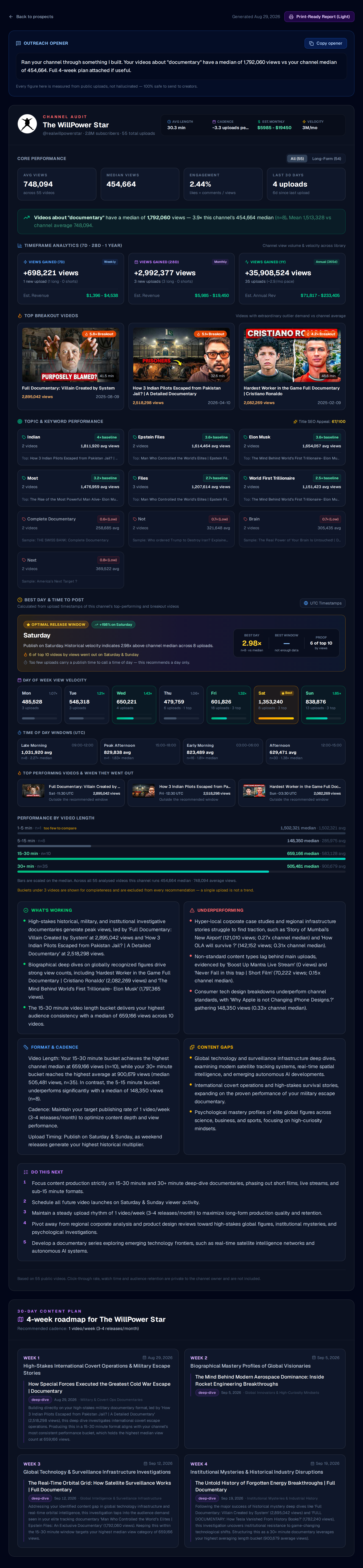
Audit any YouTube channel with verified public data. Identify breakout formats, peak upload windows, and data-backed outreach angles.
Verified channel benchmarking
Pull complete public upload histories to compute true view medians, baseline velocity, and engagement ratios across entire libraries.
POST /api/youtube-prospects/lookupVideo length velocity analysis
Classify catalog performance across specific duration tiers. Immediately uncover if long-form documentaries or shorts deliver higher median views.
GET /api/youtube-prospects/{id}Optimal upload timing engine
Calculate exact day-of-week and time-slot performance multipliers. Confirms historical velocity lifts with empirical evidence.
GET /api/youtube-prospects/{id}Standout title pattern discovery
Isolate high-performing keywords and themes that outperform channel averages while filtering out creator names and channel stop words.
GET /api/youtube-prospects/{id}Copy-ready outreach hooks
Deterministic Python calculations produce verified pitch lines for client acquisition. Eliminates fabricated claims.
GET /api/youtube-prospects/{id}Structured 30-day publishing roadmap
Transforms audit findings into a dated, 4-week content calendar focused exclusively on proven formats and verified topic gaps.
POST /api/youtube-prospects/{id}/report
03 · Content operations and workflow tracking
Bridge the gap between ideation and distribution. Manage approvals, schedules, and topic backlogs from one central board.
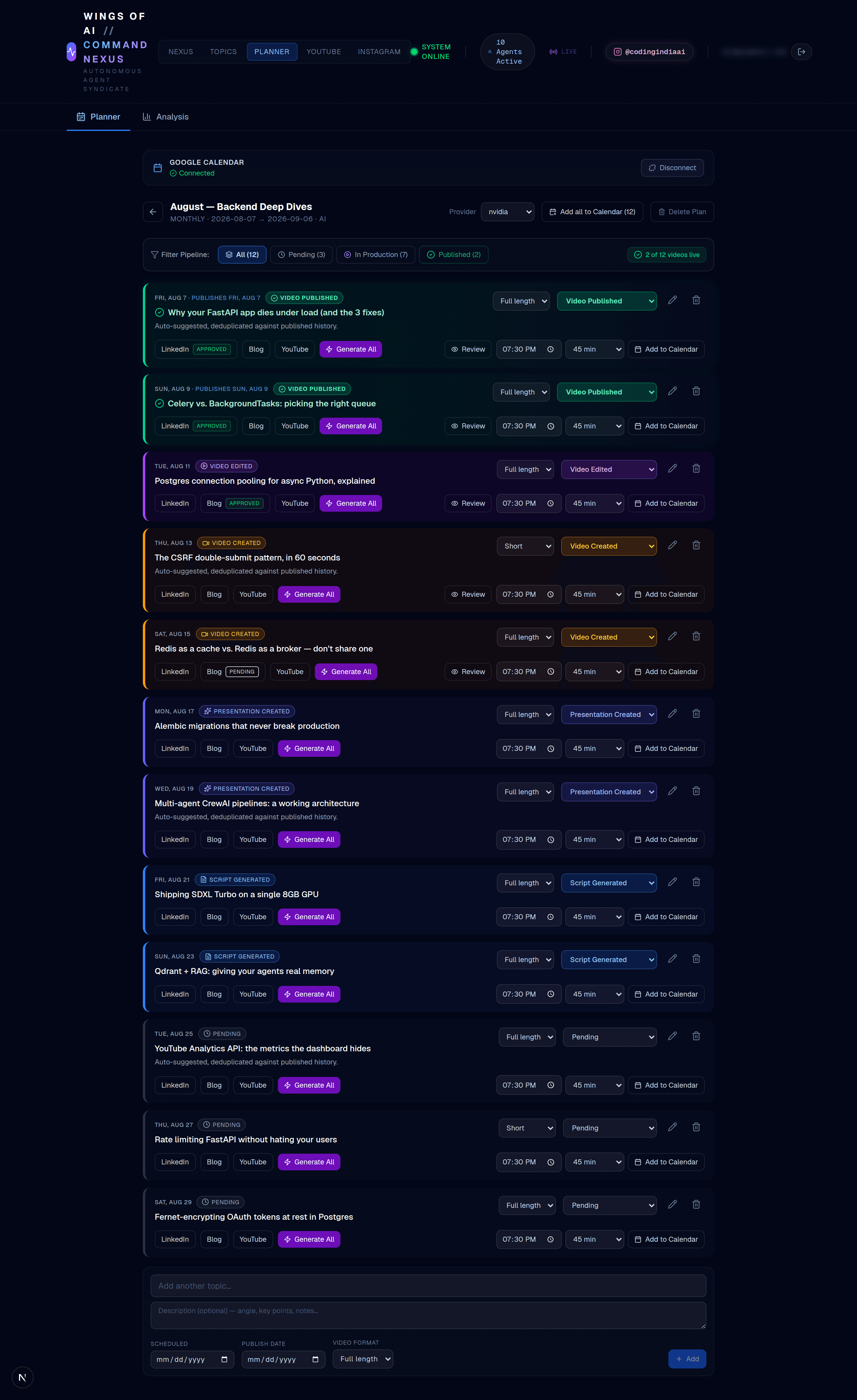
Editorial content planner
Structure weekly and monthly plans with AI suggestions deduplicated against your published archive. Publishing dates remain strictly deterministic.
POST /api/plansSix-stage production tracker
Track each asset through pending, script, presentation, video generation, editing, and published stages with clear visual indicators.
PATCH /api/plans/{id}/items/{item_id}Research backlog repository
Retain promising secondary topics uncovered during deep research runs. Build a reusable idea bank filtered by status and niche.
GET /api/saved-topicsHuman-in-the-loop review queue
Automate generation without sacrificing editorial control. Inspect full draft text, approve variations, or request revisions per channel.
GET /api/plans/{id}/items/{item_id}/contentEncrypted Google Calendar sync
Schedule approved release dates with automated reminder notifications. Authentication tokens are securely encrypted at rest.
POST /api/plans/{id}/items/{item_id}/calendarProduction velocity analytics
Monitor pipeline adherence, platform balance, review throughput, and release reliability across all active projects.
GET /api/plans/stats
Verified Intelligence
Evaluates verified metrics.Never estimates or guesswork.
Every audit, strategy brief, and roadmap evaluates live numbers synced directly from the YouTube Data API, YouTube Analytics API, and Meta Graph API. Inspect verified impressions, true retention curves, and engagement distributions stored securely in your own database.
04 · YouTube analytics and AI strategy
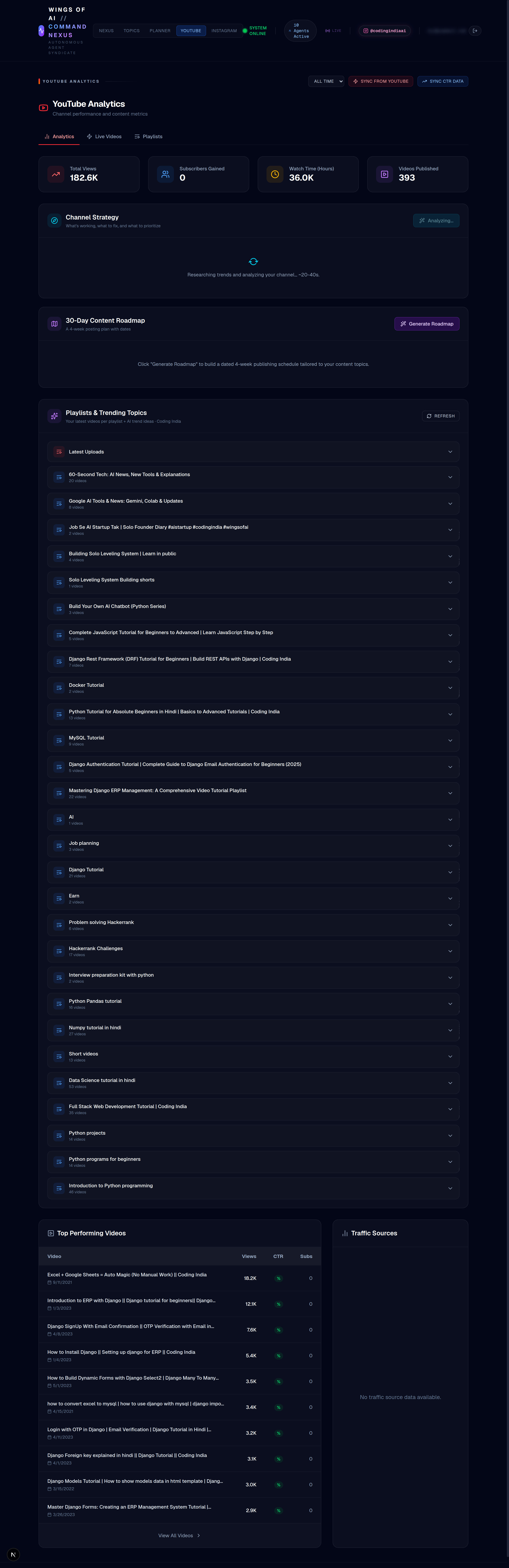
Connect directly to the YouTube Data and Analytics APIs. Power strategic assessments with verified metrics, not generic estimates.
Automated upload synchronization
Ingest video metadata, tags, durations, views, and comment velocity. Nightly scheduled jobs keep historical records current.
POST /api/youtube-analytics/sync-liveStudio-level CTR and retention
Access private Analytics API metrics including true click-through rates and average percentage viewed for deeper diagnostic depth.
POST /api/youtube-analytics/sync-analyticsMetadata and SEO diagnostics
Score title length, tag distribution, and description structure per video to pinpoint listings that need immediate optimization.
GET /api/youtube-analytics/live-videosStrategic performance briefs
Run high-tier model evaluations on synced numbers. Pinpoint growth levers, content fatigue, and high-impact next steps.
POST /api/youtube-analytics/strategyPlaylist production boards
Organize series production from initial concept to live release on an internal Kanban interface separate from public playlists.
GET /api/youtube-playlists
05 · Instagram performance and Meta OAuth
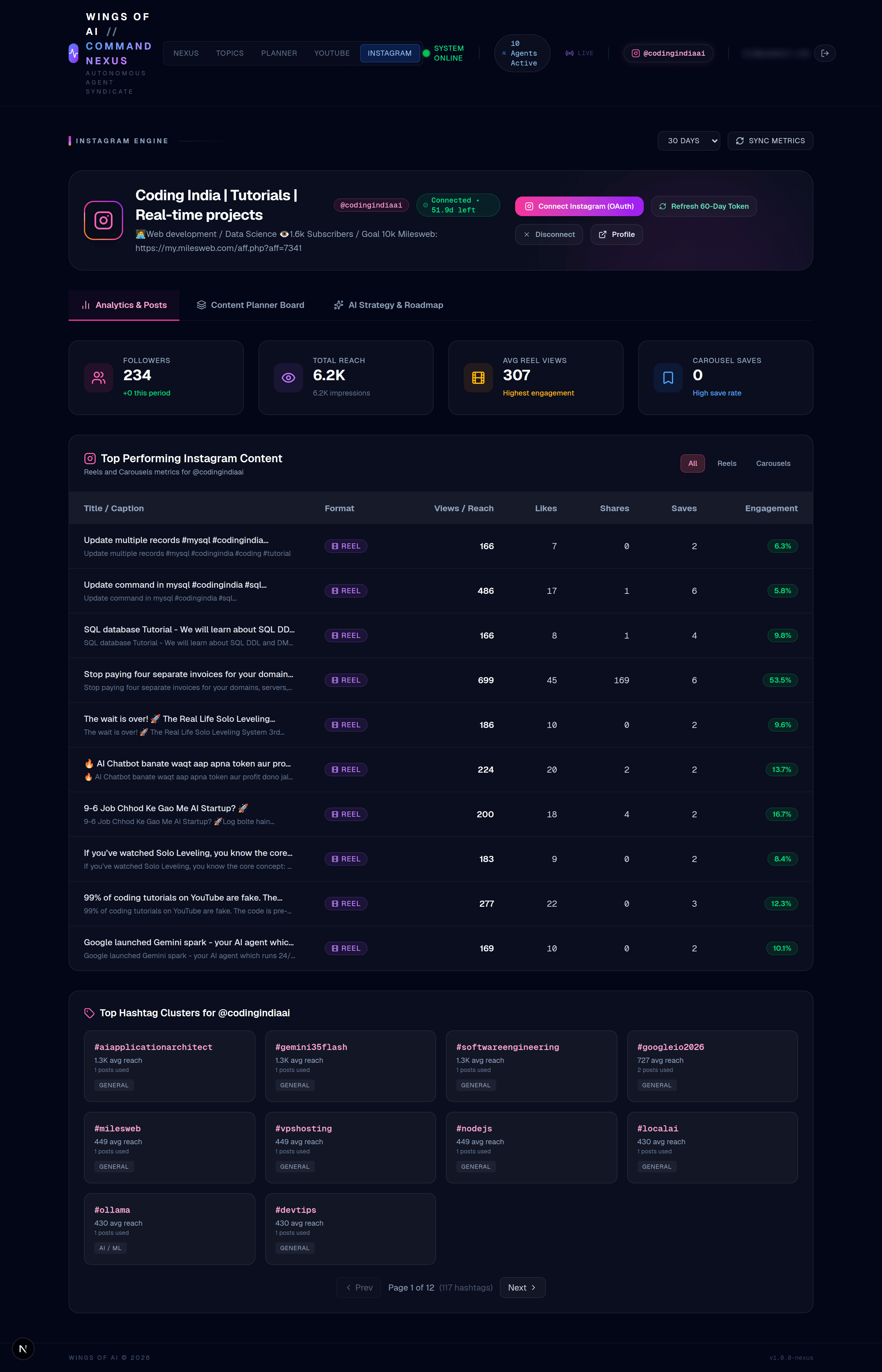
Production-grade Meta Graph integration featuring automatic token renewals, multi-tier caching, and audience reach analysis.
Long-lived Meta OAuth lifecycle
Exchanges authorization codes for 60-day tokens, securely encrypts credentials, and auto-refreshes tokens before expiration.
GET /api/instagram-auth/urlThree-tier cached read path
Routes reads through fast Redis cache and indexed database tables, accessing the Meta Graph API only on explicit sync requests.
POST /api/instagram-analytics/syncEngagement and reach metrics
Inspect account reach, impressions, profile interactions, and reel completion rates with ranked tables of top content.
GET /api/instagram-analytics/overviewReach-scored hashtag clusters
Group and score your hashtags by the median reach of posts that featured them, surfacing winning tag combinations.
GET /api/instagram-analytics/hashtagsVisual Kanban schedule board
Move image concepts, carousels, and captions through idea, production, and scheduled states with attached visual prompts.
GET /api/instagram-analytics/boardAI-powered growth roadmaps
Derive dated 1 to 8 week publishing roadmaps directly from your top-performing formats and active hashtag themes.
POST /api/instagram-analytics/roadmap
The film
Two and a half minutes, and every frame is the real product.
Full narrated walkthrough of the five-agent generation pipeline, unified editorial planner, and live YouTube & Instagram analytics hub. No mockups.
Full product walkthrough with voiceover narration and live channel telemetry.
06 · Enterprise platform and security
Engineered for reliability. Robust background workers, clean data schemas, strict authentication, and rate limiting.
First-party secure cookie auth
Features HttpOnly session cookies, CSRF protection, Redis token revocation lists, and email verification. Zero external auth vendor lock-in.
POST /api/auth/loginStrict startup route coverage guards
Every route must declare explicit authentication or be allowlisted during startup, preventing accidental public exposure.
app/main.pySegregated Redis architecture
Dedicated cache instance for analytics alongside a persistent broker instance for queue management and session security.
docker-compose.ymlDedicated background workers
Separate Celery worker pools manage LinkedIn, technical blogs, and scheduled nightly data synchronizations independently.
app/celery_app.pySemantic memory and RAG layer
Stores user guidelines and previous brand voice profiles in vector memory to tailor every agent response to your tone.
POST /api/rag/ingestLinear schema migrations
Database tables run under versioned Alembic migrations, verified and executed before web workers accept traffic.
alembic/versions/
Technical Education
Master the systems behind autonomous software.
The multi-agent architectures, distributed job queues, vector retrieval layers, and live analytics dashboards featured here reflect the exact production standards taught at Coding India Coaching Institute. Our programs equip developers, students, and engineers to construct resilient software systems.
Ship Real Code. Not Slides.
Agentic architecture
Build role-specialized agent swarms with structured handoffs, tool executions, and deterministic validation gates.
Production AI engineering
Implement vector memory, adaptive multi-provider routing, and systematic output evaluation instead of blind prompting.
Full-stack infrastructure
Construct resilient APIs, distributed background queues, event streams, and real-time telemetry consoles.
Public open-source portfolio
Deploy production software to public repositories to demonstrate real system capabilities to prospective employers.
Frequently Asked Questions
Everything you need to know about the platform.
Direct answers on channel audits, multi-agent workflows, data privacy, and calendar integration.
The audit engine queries public YouTube endpoints to ingest recent uploads, view velocity curves, duration distributions, and engagement ratios. It identifies outliers and upload patterns without accessing private channel credentials.
No. Public channel audits and competitor benchmarks do not require login credentials. You only need to authenticate with OAuth if you choose to connect your own private channel for revenue tracking and studio analytics.
Each task runs through five specialized roles. The Research Agent extracts source material. The Architect structures outlines. The Draftsman writes the content. The Critic reviews technical accuracy and brand guidelines. Finally, the Distribution Agent adapts the piece for LinkedIn, YouTube, and technical newsletters.
Yes. The editorial planner provides bidirectional synchronization with Google Calendar. Production deadlines, script reviews, and target publication windows appear directly in your team calendar with automated reminders.
Our telemetry correlates past upload timestamps with subsequent 48-hour view velocity across weekday and weekend cohorts. This separates Shorts velocity from long-form retention to pinpoint optimal publication windows.
Yes. The repurposing pipeline converts full-length video scripts into structured markdown blogs with code blocks, key takeaways, and formatted LinkedIn carousels tailored to each platform format.
Enterprise Media Infrastructure
Replace fragmented tools with one unified pipeline.
Deep research, multi-agent generation, editorial planning, calendar integration, and empirical channel intelligence in a single production console.
content.codingindia.co.in